
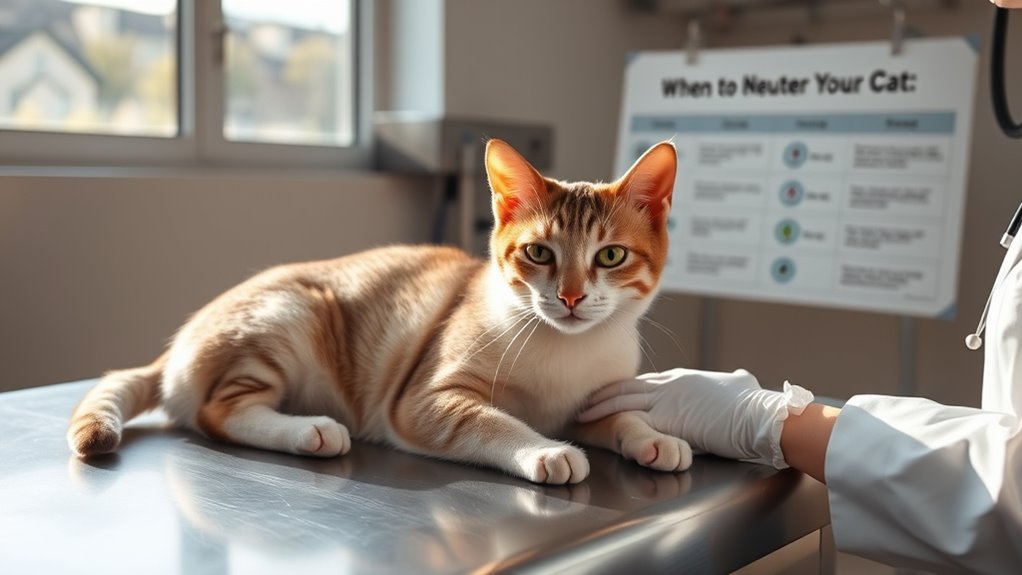
When to Neuter Your Cat: Step-by-Step Guide
You should plan to neuter your cat before 6 months for ideal health, fewer unwanted litters, and smoother behavior. Early neutering is safe—often as early as 8–16 weeks, even for rescue kittens—so talk with your vet about timing based on your cat’s health, breed, and size.
Most surgeries take a short time, and recovery is typically complete within two weeks with proper aftercare. If you want practical steps and tips, keep going.
Key Takeaways
- Typical target age: spay/neuter before 6 months, often at 4–6 months, with 8 weeks+ and 2 pounds minimum for early procedures.
- Consider health and breed: consult a vet to tailor timing for health status, weight, and breed-specific needs.
- Pre-surgery steps: follow fasting instructions (8–12 hours), arrange a quiet indoor space, and complete paperwork.
- Post-op care: limit activity 10–14 days, monitor incision daily, use an Elizabethan collar if needed, and follow pain management guidance.
- Benefits and risks: early neutering reduces cancer and behavior issues, lowers unwanted litters, and has a quick recovery with proper care.
Ideal Age to Neuter a Cat (Timing Benchmarks and Exceptions)
The ideal age to neuter a cat generally falls between 8 and 16 weeks, though many veterinarians recommend around 4 to 6 months old as a practical benchmark. You’ll find that neutering age can vary by breed, weight, and health, so age recommendations aren’t one‑size‑fits‑all. Early neutering, as young as 8 weeks and 2 pounds, is considered safe for most cats and often supports quicker recovery.
Neutering before a cat reaches its first heat (around 5 months) considerably reduces the risk of mammary tumors and prevents unwanted pregnancy, aligning with the spaying schedule many clinics follow. If you have larger or certain breeds, like Maine Coons, delaying neutering until 6 to 9 months may aid bone growth and development. Always consult your veterinarian to balance health risks with benefits, ensuring the timing respects your cat’s status, behavior, and overall well‑being.
Benefits of Neutering for Cats
Neutering offers clear health benefits for your cat, including lower risks of testicular cancer and prostate issues, plus potential protection against certain cancers with early procedures.
It also reduces unwanted litters and can lessen territorial marking and aggression, contributing to a calmer, more predictable companion.
Health Benefits Overview
Spaying or neutering your cat offers clear health benefits: it lowers the risk of testicular cancer in males and prevents ovarian and uterine cancers in females, while also reducing the chance of mammary tumors if done before the first heat.
In terms of health benefits, neutering lowers the probability of prostate problems and testicular infections in males, and it dramatically reduces mammary tumor risk when performed early neutering. You’ll also notice fewer aggressive behaviors, less roaming, and reduced territorial marking, which supports safer living and preventive care.
Behavior Improvements
You’ll notice behavioral changes after neutering, which build on the health benefits you’ve already discussed. You’ll observe calmer behavior, fewer disruptions, and smoother daily life as testosterone-driven impulses ease.
- Neutering reduces territorial behaviors like spraying and marking.
- Aggression and fighting tendency decline, lowering injury risk.
- Heat cycles stop, cutting out yowling and persistent vocalization.
- Male cats roam less, improving safety and home life.
This shift makes behavior more predictable and manageable, helping you guide daily routines, introductions with other pets, and overall care. You’ll still expect some natural personality quirks, but neutering supports a more relaxed, content cat.
The result is a better quality of life for your feline companion and less stress for you during interactions and supervision.
Population Control Impact
Population control is one of the clearest benefits of neutering, helping curb the growth of stray and feral cat populations and easing pressure on shelters and rescue resources. When you choose neutering, you prevent unwanted litters and shut down rapid population expansion from a single unspayed female cat and her offspring—potentially up to 420,000 kittens in seven years.
Widespread spaying and neutering programs slow feral cat colonies, reducing their environmental footprint and the need for shelter euthanasia. By prioritizing this step, you support healthier community ecosystems and lessen the burden on animal rescue resources. This is a practical, proactive approach to population control, benefiting outdoor cats and indoor companions alike.
Deciding the Right Timing for Your Cat (Factors to Weigh)
Choosing the right time to neuter your cat depends on several factors, including age, size, and health. You’ll weigh when neutering timing best fits your cat’s development, risks, and lifestyle. In general, most vets recommend 4 to 6 months before sexual maturity, but exceptions exist for large or slow-maturing breeds.
Rescue or shelter kittens can often be safely sterilized as early as 8 weeks and 2 pounds. Health evaluation is essential—medical conditions may delay surgery until stabilization. For outdoor cats, early intervention helps prevent unwanted breeding and related behaviors, ideally before their first heat cycle.
Consider breed considerations, which may push you toward later timing for certain pedigrees. If your cat has not reached a healthy weight or shows signs of illness, postpone until cleared by your veterinarian.
- Factors to weigh: age, size, health evaluation
- Heat cycle considerations for outdoor cats
- Early spay/neuter vs. later timing by breed
- Health risks and stabilization before procedure
What to Expect During the Neuter Procedure
You’ll go through a brief anesthesia and prep phase, then the vet makes a small incision to remove the testicles externally. The procedure uses sterile instruments and may involve sutures or surgical glue, with pain relief and antibiotics given to support recovery.
Expect a quick, routine surgery with careful monitoring and a smooth, low-risk recovery.
Anesthesia And Prep
Anesthesia and prep for a neuter is straightforward: your cat will receive general anesthesia so they’re pain-free and completely still during the procedure. You’ll get pre-anesthetic medications to relax your cat and reduce anxiety, setting the stage for a smooth surgery.
During the procedure, monitoring vital signs ensures safety, keeping an eye on heart rate, oxygen, and respiration. The surgical area is shaved and disinfected to minimize infection risk, and the disinfected incision is made externally in male cats.
After surgery, your cat goes to post-surgery recovery, where they’re observed until fully awake and stable.
- pre-anesthetic medications for relaxation and pain control
- general anesthesia keeps your cat pain-free and immobile
- surgical area preparation and disinfected incision
- monitoring vital signs and post-surgery recovery readiness
Incision And Recovery
During neutering, the incision placement depends on the surgery type: a small cut in front of the scrotum for most male cats or an abdominal incision for females. You’ll notice the surgeon closes the incision site with sutures, staples, or surgical glue designed for quick healing and minimal discomfort. The procedure itself is brief—about 15-20 minutes for males and 30-90 minutes for females—during which reproductive organs are removed.
After surgery, monitoring begins right away as the incision area is checked for swelling, bleeding, or signs of infection. In the recovery phase, keep the incision site clean and dry, limit activity, and follow your veterinarian’s post-surgery care instructions. Most cats go home within a few hours, with healing expected in 10-14 days.
Preparing for Surgery: Pre-Op Steps and Day-of-Care
Getting your cat ready for neutering starts with a quick health check and timing. You should confirm your cat is in good health, at least 8 weeks old and 2 pounds, before scheduling. Follow your veterinarian’s instructions for fasting, typically withholding food and water for 8-12 hours prior to surgery.
Prepare a quiet, indoor recovery space where your cat can rest undisturbed after the procedure, and remove any collars or accessories that could interfere with the surgery or wound healing. Ensure all pre-surgical paperwork and consent forms are completed and discuss any concerns with your veterinarian beforehand.
- preoperative care: review health status and age/weight requirements
- fasting: adhere to the 8-12 hour rule for food and water
- surgical preparation: secure a calm environment and remove accessories
- consent forms and day-of-care: confirm paperwork and ask questions
Post-op instructions come after recovery planning, not here, to keep focus on pre-op steps.
Post-Operative Care and Recovery Expectations
Most cats recover comfortably within 24–48 hours after neutering, but activity should remain limited for the first 10–14 days to protect the incision. You’ll notice the healing process progresses steadily with daily post-operative monitoring of the incision site for signs of infection, swelling, or bleeding. Use pain management medications as directed to keep your cat comfortable during this period.
To maintain rhythm and clarity, consider this quick guide:
| Step | Tip |
|---|---|
| Activity levels | Keep activity restrained; short, supervised outings only. |
| Incision site | Check daily; contact your vet for concerns like redness or discharge. |
| Protective gear | An Elizabethan collar prevents licking and biting, aiding healing. |
Full recovery typically occurs within two weeks, though individual variation happens. If pain control or appetite changes, consult your veterinarian promptly. With careful monitoring and adherence to instructions, most cats resume normal behavior and activity as healing completes.
Common Timing Myths and Evidence-Based Answers
Many timing myths around spaying and neutering persist, but solid evidence shows that waiting isn’t safer and early intervention is generally advantageous. You’ll find that delaying surgery raises risks like mammary tumors and other reproductive issues, especially if the cat is in heat.
Early spaying at 8-16 weeks is supported by studies and does not stunt growth or bone development. The health benefits extend beyond cancer risk reduction, including fewer unwanted litters and easier anesthesia and recovery when done before 6 months.
Myths about obesity or behavioral problems are unfounded; proper diet and training matter more. The ideal timing depends on your cat’s factors, but current evidence supports surgery before 6 months for most cats.
- spay/neuter timing: aim before 6 months to maximize health benefits
- early spaying reduces mammary tumor risk and reproductive issues
- myths about neutering: diet and training drive behavior, not timing
- cat in heat isn’t a reason to delay surgery; safety and outcomes improve with earlier procedure
Frequently Asked Questions
What Is the Best Age to Neuter a Cat?
The best age to neuter your cat is between 8 and 16 weeks, ideally before they reach sexual maturity. You should consider early neutering as it helps prevent spraying and roaming, and it doesn’t stunt growth or weight when managed properly.
Some larger breeds or health issues might tilt you toward waiting until 6–9 months, but overall, early neutering is beneficial and commonly done in rescue or shelter settings.
How Do I Know When My Cat Is Ready to Be Neutered?
You’re right to wonder, and yes, you’ll know when your cat’s ready: steady weight around 2 pounds, good health, and clear vet approval. But don’t wait for dramatic signs like a midlife crisis—neutering earlier is wiser.
Most cats reach maturity by 4 to 6 months; girls can hit first heat by 4–5 months. Schedule a pre-surgical check, confirm blood work if needed, and follow your vet’s cue that it’s safe to proceed.
What Are the Rules Before Getting a Cat Neutered?
Before getting a cat neutered, you should have your vet confirm the cat is healthy to proceed. Make certain the cat weighs at least 2 pounds and has had a recent check-up. Plan for 8–12 hours of fasting before anesthesia, and discuss medications or conditions that could affect surgery.
Arrange a quiet recovery space and follow post-op instructions, including activity restrictions. Ask about any breed- or age-specific considerations your vet recommends.
Why Wait Until 6 Months to Spay a Cat?
Waiting until 6 months helps you balance safety and behavior. You avoid anesthesia risks seen in very young kittens, and you reduce chances of heat-related behaviors if you wait too long.
Spaying by or before 6 months also supports population control and may lower mammary cancer risk. Yes, there’s a slight trade-off with longer recovery, but most cats recover well.
Conclusion
You’re not just choosing a date—you’re choosing a future for your feline friend. Think of neutering as a quiet seed you plant in spring, promising calmer days, safer adventures, and fewer accidental litters.
It’s a shield, not a shackle, wrapping your cat in healthier habits and longer, happier chapters. Trust your instincts, heed your vet’s guidance, and ride the wave of recovery with patience.
In the end, care blooms like a well-tended garden—steady, resilient, and full of promise.