
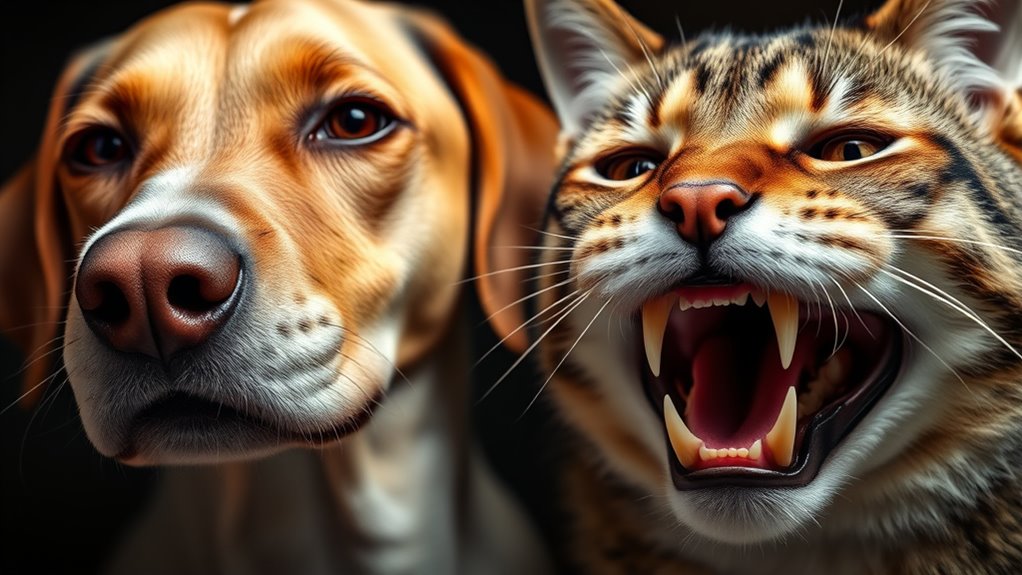
10 Facts Comparing Do Dogs or Cats Have Sharper Teeth
Dogs generally have sharper, more robust teeth for a versatile, bone-cracking bite, while cats boast highly specialized, piercing teeth designed for slicing flesh.
You’ll notice dogs have more teeth (42 vs. 30) and flatter molars for grinding.
Cats sport long canines and blade-like premolars for tearing.
Bite force also differs—dogs can hit up to ~450 psi, cats around 150–200 psi.
If you want more details, there’s plenty to uncover beyond this overview.
Key Takeaways
- Dogs have generally sharper and sturdier teeth for tearing, shredding, and bone-crushing, with 42 teeth total compared to cats’ 30.
- Cats have needle-like canines and blade-style premolars/molars optimized for piercing and slicing flesh.
- Dogs’ molars are flatter with ridges for grinding a varied diet; cats’ teeth prioritize slicing and tearing over grinding.
- Bite force tends to be higher in dogs (up to 200–450 psi) than in cats (about 150–200 psi), supporting different chewing demands.
- Dental issues differ: cats show more resorptive lesions and periodontal disease, while dogs often face plaque and tartar buildup on flatter molars.
Why Are Dog Teeth Sharper Than Cat Teeth?
You might wonder why dog teeth often seem sharper than cat teeth, and the answer lies in their different roles and anatomies. You’ll notice that dogs have more teeth—42 versus 30—which contributes to sharper, more pointed structures for tearing and biting. Their canines are longer and more robust, built to grab and puncture, giving you a sense of power in each bite.
The premolars and molars in dogs also feature sharper edges, aiding in crushing bones and tough foods rather than delicate slicing alone. This design aligns with a higher bite force, ranging from about 200 to 450 psi, which reinforces the impression of sharp teeth that can deliver a strong, effective bite.
In contrast, cats have teeth that are more delicate and highly specialized for slicing meat, prioritizing precision over sheer sharpness. So, you see sharp teeth in dogs tied to function, not just appearance.
Do Dogs Have More Pointed Canines Than Cats?
Do dogs have more pointed canines than cats? Not necessarily. You’ll find that both species have prominent canines, but their shapes differ to match their predatory adaptations. Dogs typically show large, pointed canines that are great for gripping and tearing, yet many breeds have canines that are broad enough to shred flesh rather than to pierce.
Cats, meanwhile, possess extremely sharp, dagger-like canines that are longer relative to their skull size and optimized for piercing. In practice, cats’ canines are generally more pointed and needle-like, reflecting their specialized hunting style. You’ll notice that dogs’ canines emphasize grasping and shredding, while cats’ emphasize precision piercing.
How Do Dog and Cat Premolars and Molars Differ in Shape and Function?
You’ll notice that dog premolars and molars mix pointed cusps with flat surfaces for a versatile chew, while cat premolars and molars are more blade-like and specialized for shearing flesh.
This shapes how you interpret their chewing methods: dogs handle a wider diet, cats focus on efficient slicing.
Premolars And Molars Shapes
Dog and cat premolars and molars differ in shape to support their diets: dogs have sharp, serrated edges for tearing flesh and crushing bones, while cats feature blade-like, scissors‑style surfaces optimized for shearing meat.
You’ll notice premolars and molars reflect their dietary niches: dogs’ molars are flatter with ridges to grind a varied, omnivorous diet, whereas cats lack extensive grinding surfaces, prioritizing tearing.
This teeth shape distinction highlights how each species processes food differently, guiding how you interpret their biting tools. The table below compares premolars and molars to emphasize structure over function, focusing solely on shape.
| Feature | Shape emphasis |
|---|---|
| Premolars | Serrated vs. blade-like |
| Molars | Flat ridges vs. minimal grinding surfaces |
| Overall | Teeth shape dictates processing style |
| Diet correlation | Omnivore vs. carnivore |
Function Differences In Chewing
From the shapes we’ve just examined, the way dogs and cats chew reflects their feeding roles: premolars and molars aren’t just about grinding—they’re tuned for how each species processes meat.
You’ll notice dogs use sharp, pointed edges to tear flesh and crush bones, blending crushing with tearing. Cats rely on razor-sharp, scissor-like edges that slice meat with surgical precision during hunting.
Unlike humans, dog and cat molars stay narrow and pointed, prioritizing piercing over broad grinding surfaces. This design emphasizes function: dogs as scavengers and hunters, cats as dedicated meat-slicers, all shaping their chewing patterns.
Carnivore Dentition Adaptations
Carnivore dentition is shaped by meal needs: dogs and cats have premolars and molars that reflect distinct roles in meat processing. You’ll notice carnivorous teeth differ in function: dogs use premolars and molars with sharp cusps for crushing, shredding, and bone breaking, supporting a versatile feeding style.
Cats rely on blade-like premolars and molars that excel at shearing flesh, acting like scissors to tear meat apart. The dog’s molars feature ridges and cusps optimized for grinding and crushing, aligning with a more omnivorous tolerance.
In contrast, cat molars emphasize slicing over grinding, limiting plant material processing. Overall, feline premolars and molars are sharper and more blade-like than those of dogs, underscoring adaptations for a strict carnivorous diet, and guiding how you interpret their chewing habits.
How Does Jaw Strength Affect Bite and Tooth Performance?
Even though bite and tooth performance hinge on many factors, jaw strength plays a central role in determining how effectively an animal can process food and defend itself. You can see how higher jaw strength translates into stronger bite force and better tooth performance across species, shaping what they can chew and how hard they can bite.
Jaw strength drives bite force and tooth performance across species.
- Higher jaw strength directly boosts bite force, enabling tougher foods to be processed.
- A stronger jaw supports more efficient tooth wear patterns, preserving tooth performance over time.
- Variations in jaw pressure reflect dietary needs, linking muscle power to feeding strategies.
- The relationship between jaw strength and bite performance helps explain defensive capabilities in different animals.
In dogs, 200–450 psi enables bone crushing and hard-food chewing, while cats’ 150–200 psi suits predation tasks. Humans’ 60–70 psi underscores their generalized diet.
How Diet Drives Tooth Design: Omnivore Versus Carnivore
Diet shapes tooth design in clear, functional ways: carnivores like cats evolve sharp, blade-like teeth and long canines for gripping and tearing, while omnivores like dogs blend cutting edges with flatter premolars and molars to grind plant material. You’ll notice teeth reflect diet, not just appearance: carnivores feature blade-like edges and pronounced canines for puncturing and capturing prey.
Omnivores show a mix of tearing surfaces plus flatter grinding teeth to process plant material, enabling a flexible diet. The tooth ensemble mirrors feeding needs, with carnivores having fewer molars and specialized canines, emphasizing slicing efficiency. Omnivores, by contrast, possess more versatile teeth that handle both animal tissue and plant matter.
This design interplay demonstrates how biology optimizes structure for function: teeth structure aligns with dietary strategy, supporting efficiency in capturing, tearing, grinding, and processing foods. In short, diet drives tooth design, shaping carnivores and omnivores differently.
Do Cats Really Have Fewer Cavities Than Dogs or Humans?
You might wonder if cats really get fewer cavities than dogs or humans. With their enamel, tooth shape, and carnivorous diet, cats have far less opportunity for cavity-forming pits and bacteria.
In short, cavities are exceedingly rare in cats, while periodontal disease and tooth resorption are more common dental issues.
Cavities Comparison Across Species
Cavities vary a lot across species, and cats really do stand out for having far fewer dental caries than dogs or humans. You’ll see that feline dental health benefits from teeth shaped to minimize cavity-prone areas, and from diets that reduce decay risk. Historically, cavities in domestic cats are extremely rare, mostly documented in fossil records rather than living animals, a point you’ll want to remember.
Proper dental care further lowers the already small risk compared with humans and canines.
- Cats lack occlusal surfaces and pits where bacteria cause decay
- Canine teeth are more prone to surface wear than in felines
- Diet contributes considerably to cavity incidence
- Cavities are remarkably uncommon in living cats compared with humans and dogs
Cat Dental Cavity Protection
Do cats really have fewer cavities than dogs or humans? Not really surprising: your cat’s teeth and diet inherently curb cavities. You’ll notice cat teeth aren’t built with horizontal surfaces or pits that trap bacteria, so dental cavity protection starts with anatomy.
The shape of feline teeth and their diet reduce occlusal tables, common cavity sites in humans and dogs, making cavities extremely rare. In practice, you won’t see the same caries patterns you’d expect in other species. Most dental issues you’ll encounter are resorptive lesions and periodontal disease, not cavities.
Historical data even shows cavities are virtually absent in cats. For overall feline dental health, prioritize routine check-ups, proper brushing, and monitoring for gum problems to maintain healthy cat teeth.
Which Species Uses Teeth for Hunting Versus Feeding?
Dogs and cats differ in how they use their teeth for hunting and feeding. You’ll notice dogs rely on strong, sharp canines and molars to hunt, bite, and tear prey, reflecting their predatory role, while also feeding on varied items with bone-cracking strength.
- sharp teeth: Dogs pair brute force with biting to secure prey, aligning hunting and feeding needs.
- hunting: Cats have dagger-like canines and specialized teeth for piercing and shearing flesh during hunting.
- feeding: Cats’ teeth focus on capturing and dismembering prey rather than prolonged chewing, unlike dogs.
- distinction: The size and sharpness of a cat’s canines enable quick immobilization, highlighting hunting specialization.
Bite Mechanics: Up-And-Down Vs Side-To-Side Movement
You’ll compare how up-and-down jaw motion contrasts with side-to-side crushing dynamics in dogs and cats.
Consider how teeth design and function support these motions, shaping each species’ feeding strategies.
This sets the stage for exploring how bite mechanics influence hunting, processing, and diet.
Up-And-Down Jaw Motion
Up-and-down jaw motion is the primary biting strategy for cats, enabling precise puncturing and tearing of flesh with a vertical bite. You’ll notice this motion suits their carnivorous diet, focusing energy through the canines and sharp teeth for clean cuts. Compared with dogs, your jaw motion remains mostly vertical, minimizing grinding.
Here’s how it breaks down:
- Up-and-down action concentrates force for slicing.
- Sharp teeth optimize puncture and tearing efficiency.
- Canine teeth act as primary biting tools in vertical trajectories.
- Limited lateral movement reflects a specialized hunting style.
In this framework, your jaw motion highlights vertical strength over grinding, aligning with feline predatory needs and distinguishing your sharp teeth from broader canine adaptations seen in dogs.
Side-To-Side Crushing Dynamics
While both species rely primarily on vertical biting, side-to-side crushing plays a limited role in their bite dynamics. You’ll notice that sharp teeth mainly support vertical force, not grinding, so side-to-side motion stays modest.
In feeding behavior, you observe that jaw movement emphasizes up-and-down action, aligning with how they tear and puncture rather than grind. Cats and dogs share a similar pattern: their molars and premolars are structured for shearing and piercing, not grinding, reinforcing the minimal role of horizontal grinding during meals.
This means side-to-side crushing isn’t a dominant feature, even when you compare their bite mechanics. If you focus on jaw movement, you’ll see vertical force drives how they process hard foods and bones in practice.
Teeth Design And Function
Cats and dogs differ particularly in how their teeth and jaw joints support bite mechanics. You’ll notice one uses up-and-down slicing mainly, while the other blends vertical power with some lateral action. Here’s the gist:
- Dogs unleash strong jaw muscles and bite pressure, enabling up-and-down biting up to 450 psi.
- Cats exhibit a more limited bite force, around 150–200 psi, focused on vertical slicing.
- Cats’ mandibular joint is specialized for up-and-down motion, aiding flesh shearing.
- Dogs’ jaw joints support a broader range of biting mechanics, including lateral movement.
Quick Comparison: Tooth Counts and Roles (Humans, Dogs, Cats)
Humans usually have 32 teeth designed for cutting, tearing, and grinding. In this quick comparison, you’ll see how tooth counts and roles differ across species. Humans have 32 teeth total, including incisors, canines, premolars, and molars, all suited to mixed eating tasks.
Dogs typically show 42 teeth, with prominent canine teeth and sharp premolars that help biting, grasping, and shredding prey or bones. Cats have 30 teeth, featuring long, sharp canines and specialized molars for piercing and tearing meat efficiently.
The size and sharpness of canine teeth are generally larger and more pronounced in dogs and cats than in humans, reflecting their hunting roles. Overall, cats and dogs have sharper teeth than humans, with cats possessing the most specialized and pointed dentition for hunting.
When you compare tooth counts, you’re also comparing functional roles: humans for varied diets, pets for meat processing and capture.
Practical Takeaways for Pet Dental Care
Caring for your pet’s teeth means balancing attention to both sharp feline teeth and flatter canine molars, so you can prevent dental disease while supporting comfortable eating and hunting instincts.
Caring for your pet’s teeth means balancing attention to both sharp feline teeth and flatter canine molars.
In practice, tailor care to each bite type: sharp teeth for cats, flat molars for dogs, and keep oral health a priority for both.
- Maintain daily brushing or interactive dental treats to reduce plaque buildup on sharp teeth and flatter chewing surfaces.
- Schedule regular veterinary cleanings to monitor gum health, tooth wear, and potential dental disease in both species.
- Use species-appropriate dental diets that support enamel and tartar control without compromising nutrition.
- Pair preventive care with monitoring of eating changes, drooling, or bad breath, which can signal issues beyond tooth sharpness or flatness.
Frequently Asked Questions
Are Cat Teeth Sharper Than Dogs?
Yes, cat teeth are sharper than dog teeth. You’ll notice their canines are longer and pointier, and their premolars and molars are shaped to slice flesh.
You’ll often see cats puncture and tear prey with precision, rather than crush it like many dogs do. So, in general, you’ll find cats have sharper, more needle-like teeth suited for piercing and shearing compared to dogs.
What Animal Has the Sharpest Teeth?
You’d say cats have the sharpest teeth overall, especially their elongated canines and needle-like fangs, designed for precision slicing and piercing flesh. You’ll note that among common household carnivores, cats stand out for sharpness, while dogs have strong teeth too but are broader for tearing.
You’ll recognize that many species—like certain wild cats—exceed typical domestic carnivores in tooth sharpness, but for everyday intuition, cats top the list in sharpness.
Why Do Cats Have Sharp Teeth?
Cats have sharp teeth because they’re built for hunting and killing prey. About 30% of their bites come from incisors and canines used to seize, puncture, and hold. Their elongated canines deliver precise, quick punctures, while sharp premolars and serrated molars tear flesh efficiently.
This carnivorous design helps them process meat, not plants, and enables them to hunt with precision and effectiveness. Your cat’s bite reflects a specialized, survival-focused dental toolkit.
Are Dog Claws Sharper Than Cats?
No, dogs don’t have sharper claws than cats. Cats’ claws are sharper and retractable, extending about 1 to 2 inches, designed for hunting and climbing. Your dog’s claws are thicker, less curved, and built more for digging and traction, so they feel blunter.
Regular scratching helps cats keep theirs pointed. For you, this means cats rely on precision grip, while dogs rely on sturdier, blunt claws for practical tasks.
Conclusion
You’ll see that dogs’ teeth are sharper in certain areas, while cats rely on precision bites and slicing canines. Your takeaway: diet and lifestyle shape tooth design, and jaw strength drives bite power.
It’s a rhythm like a pendulum—tearing, biting, slicing, gnawing—each species tuned to its needs. For your pet, regular dental care keeps both sharpness and health in check, so you’ll enjoy safer, happier kibbles, squeaky toys, and purring or wagging without dental drama.